
.avif)

According to Gartner, over 60% of supply chain leaders in 2023 said they were exploring blockchain to improve transparency and cut down on fraud. Yet for most procurement teams, the idea still feels distant, more concept than reality.
Blockchain is beginning to change how organizations manage sourcing, contracts, payments, and supplier relationships. At its core, it promises something procurement has long struggled with: reliable trust, built into every transaction. But how practical is it for your business today? And does the benefit outweigh the effort to adopt it?
- Blockchain in procurement acts as a decentralized digital ledger that creates an immutable and transparent record of every transaction, significantly reducing the risk of fraud and data tampering.
- One of the most transformative aspects of blockchain in procurement is the use of "smart contracts," which automatically trigger payments to vendors once pre-defined delivery conditions are met, eliminating manual administrative delays.
- Implementing blockchain in procurement enhances supply chain traceability, allowing companies to verify the exact origin and journey of raw materials to ensure they meet ethical and sustainability standards.
- By providing a "single source of truth" for all parties, blockchain in procurement reduces disputes between buyers and sellers by ensuring everyone has access to the same verified data regarding orders and shipments.
- Adoption of blockchain in procurement streamlines the auditing process, as the permanent and time-stamped nature of the records allows for real-time compliance monitoring without the need for manual reconciliation.
What is Blockchain in Procurement?
Blockchain in procurement uses a decentralized, tamper-proof digital ledger to record and verify every transaction across sourcing, contracts, and payments. It improves transparency, speeds up verification, and builds trust between buyers and suppliers by creating a single, reliable source of truth for procurement activities.

Why Blockchain in Procurement is Important
Blockchain brings transparency, security, and trust to procurement - three things that traditional systems often struggle with. It helps businesses verify transactions, reduce fraud, and gain real-time visibility across the entire supply chain.
Here’s why blockchain is becoming a game-changer in procurement:

Enhances Supply Chain Transparency
Blockchain creates a shared, unchangeable record of transactions. Every supplier, product, and payment is traceable in real time. This helps procurement teams monitor goods throughout the supply chain, reducing the risk of counterfeits and delays.
Reduces Fraud and Errors
Since blockchain records cannot be altered, it drastically reduces opportunities for tampering, fraud, and duplicate payments. This immutable recordkeeping helps ensure that every action - whether it’s a contract or a shipment - is verified and accurate.
Builds Trust Between Stakeholders
In procurement, trust is everything. Blockchain eliminates the need for intermediaries by allowing all parties to validate transactions independently. This builds confidence among buyers, suppliers, and auditors.
Improves Contract Management
Smart contracts - automated agreements that execute when conditions are met - can streamline procurement workflows. Payments can be auto-triggered when goods are delivered, reducing manual checks and accelerating cash flow.
Supports Compliance and Auditing
Blockchain simplifies compliance by providing a complete audit trail of every procurement activity. Auditors can instantly verify data, reducing time and effort spent on manual reporting.
Increases Efficiency and Speed
Procurement often involves multiple systems and checkpoints. Blockchain consolidates these processes, cutting down time spent on approvals, verifications, and reconciliations. Faster processing leads to quicker decision-making.
Enables Better Supplier Performance Tracking
With all supplier transactions recorded on a blockchain, it's easier to assess performance over time. Procurement teams can identify reliable vendors, detect issues early, and make informed sourcing decisions.
Blockchain is not just a new technology - it’s a new foundation for procurement that prioritizes accuracy, accountability, and agility.
The Role of Blockchain in Smart Contracts
Smart contracts are digital agreements that automatically execute once set conditions are met. In procurement, they remove manual steps by triggering payments or approvals when specific criteria like delivery confirmation are fulfilled. This not only speeds up transactions but also reduces disputes and errors, ensuring smoother collaboration between buyers and suppliers.
Blockchain isn’t just a new technology; it’s a foundation for more accurate, accountable, and agile procurement.
Blockchain vs Traditional Procurement Systems
Traditional procurement systems rely heavily on manual checks, siloed data, and intermediaries. Blockchain replaces these with automation, transparency, and decentralized trust - making procurement faster, more secure, and more accountable.
Here’s how blockchain compares with legacy procurement systems:
| Aspect | Traditional Procurement | Blockchain-Based Procurement |
|---|---|---|
| Data Storage | Centralized and siloed across departments or systems | Decentralized and shared across all stakeholders |
| Transaction Visibility | Limited visibility; updates are often delayed or incomplete | Real-time visibility; all parties see the same data |
| Verification Process | Manual document checks and approvals | Automated, tamper-proof verification through smart contracts |
| Payment Triggers | Manual approvals and delays in payment processing | Payments auto-triggered by smart contract conditions |
| Audit and Compliance | Requires collecting and aligning records from multiple sources | Immutable audit trail always available |
| Security and Tampering | Susceptible to data manipulation or unauthorized changes | Tamper-proof ledger with cryptographic validation |
| Supplier Onboarding | Time-consuming and repetitive across systems | One-time verification stored securely on blockchain |
Blockchain modernizes procurement by eliminating many inefficiencies in the traditional model, helping teams work faster and with greater confidence.
How Blockchain Works in Procurement
Blockchain doesn’t just tweak existing procurement workflows - it reimagines them. By replacing manual processes with secure, automated systems, it builds transparency and trust into every step.
Purchase Order Validation
This is the first step in any procurement cycle - where mistakes or miscommunication can lead to costly delays.
Without Blockchain: When a purchase order is created, it must be manually reviewed, emailed to vendors, and sometimes printed for signatures. There’s room for delays, errors, and even manipulation of terms post-approval.
With Blockchain: Purchase orders are recorded on a shared digital ledger and time-stamped. All stakeholders see the same version instantly. The blockchain locks the order data, preventing edits and ensuring total transparency from the start.
Supplier Verification
Procurement teams must verify vendor legitimacy and compliance before finalizing deals - a process that can be time-consuming and inconsistent.
Without Blockchain: Supplier vetting requires third-party checks, reference calls, and document validation. This information often lives in siloed systems or emails, making audits difficult and slow.
With Blockchain: Vendor credentials and certifications can be verified instantly through blockchain-backed digital IDs. Each update is time-stamped and visible to all stakeholders, ensuring ongoing compliance and reducing onboarding time.
Contract Creation and Execution
Procurement relies heavily on contracts - drafting, reviewing, and executing them is often a bottleneck.
Without Blockchain: Contracts are shared over email, edited in multiple versions, and manually signed. Tracking who made what change can become a nightmare, and missed terms can delay execution.
With Blockchain: Smart contracts automate execution once conditions are met (e.g., delivery confirmation triggers payment). Terms are locked on the blockchain, ensuring transparency, automatic enforcement, and real-time tracking.
Goods Receipt and Delivery Confirmation
Receiving goods or services needs quick validation - but traditional systems often lack real-time tracking.
Without Blockchain: Delivery confirmations are handled through paper slips, scanned documents, or emails. There’s often a lag between delivery and system updates, leading to reconciliation issues later.
With Blockchain: Every delivery is time-stamped on the blockchain with digital proof of receipt. This data is instantly visible to all parties, reducing disputes and ensuring accurate records for audits.
Invoice Approval and Payment
This stage is highly prone to delays, disputes, and duplicate or incorrect payments.
Without Blockchain: Invoices are manually matched with POs and delivery notes. Any mismatch requires back-and-forth communication, slowing down payments and frustrating suppliers.
With Blockchain: Invoices, POs, and delivery records are linked and automatically validated on the blockchain. Smart contracts release payments only when all terms match, eliminating delays and overpayments.
Auditing and Compliance
Every procurement activity must be audit-ready - but traditional systems make this harder than it needs to be.
Without Blockchain: Audit trails are scattered across emails, spreadsheets, and ERP systems. Verifying transactions means chasing down documents and aligning inconsistent formats.
With Blockchain: Every procurement action is immutably recorded on the blockchain. Auditors get real-time access to a unified, tamper-proof log - saving time and improving compliance with minimal manual effort.
Challenges of Implementing Blockchain in Procurement
While blockchain brings major advantages, adoption in procurement can be complex. Understanding the obstacles and how to solve them makes the difference between a stalled pilot and a successful rollout.
Here are the most common challenges and practical ways to address them:
Lack of Technical Expertise
Challenge: Many procurement teams don’t have the technical knowledge to evaluate or manage blockchain systems.
Solution: Partner with external specialists or select tools that offer easy onboarding, built-in support, and clear documentation.
Integration with Existing Systems
Challenge: Most organizations already use ERP or procurement tools that aren’t built to work with blockchain.
Solution: Choose blockchain platforms designed for compatibility or use APIs to connect with your current systems.
High Initial Investment
Challenge: Blockchain implementation can require a sizable upfront budget for infrastructure and setup.
Solution: Start with a small pilot project to prove ROI and build internal confidence before expanding organization-wide.
Resistance to Change
Challenge: Employees and suppliers may hesitate to adopt new systems due to unfamiliarity or perceived disruption.
Solution: Offer training, communicate benefits clearly, and demonstrate how blockchain simplifies daily tasks.
Regulatory Uncertainty
Challenge: Laws governing blockchain and smart contracts are still evolving, which can create hesitation.
Solution: Stay informed about legal developments and focus on compliant, low-risk use cases until regulations stabilize.
Data Privacy Concerns
Challenge: Sharing procurement data on a distributed ledger raises concerns about visibility and control.
Solution: Use private or permissioned blockchains with encryption and role-based access to protect sensitive information.
Key Benefits of Using Blockchain in Procurement
Blockchain helps procurement teams eliminate inefficiencies, reduce risk, and gain real-time visibility across the supply chain. Its decentralized nature brings accuracy, speed, and trust into every transaction.
Here are the key benefits of using blockchain in procurement:
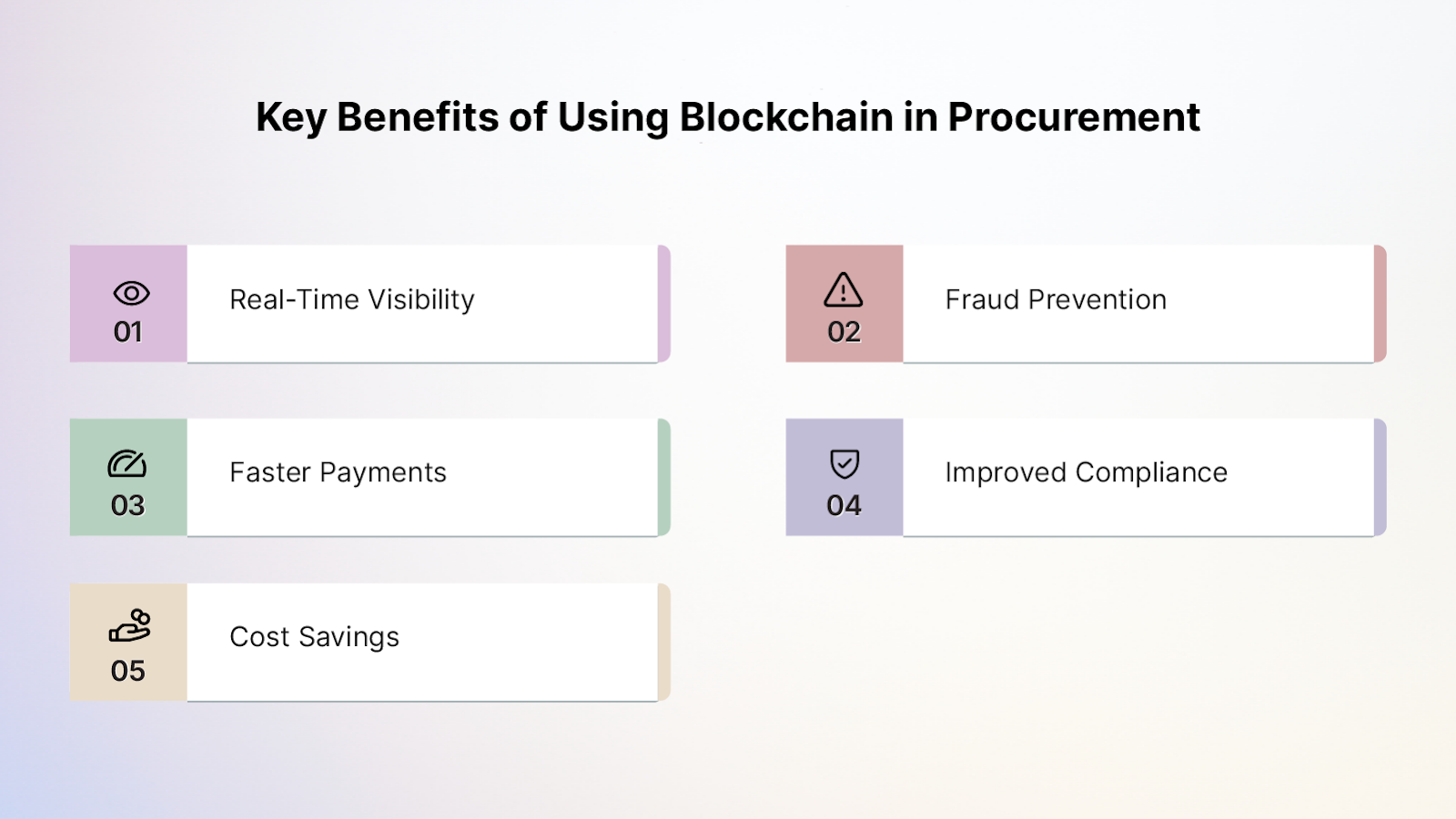
Real-Time Visibility
Every transaction is recorded instantly and shared across stakeholders, enabling real-time tracking of orders, deliveries, and payments. No more chasing updates or relying on outdated systems.
Fraud Prevention
Blockchain’s tamper-proof structure makes it nearly impossible to alter records. This reduces the risk of fake invoices, duplicate payments, or unauthorized purchases.
Faster Payments
Smart contracts trigger automatic payments once conditions are met. This speeds up the payment cycle, improves cash flow, and strengthens supplier relationships.
Improved Compliance
Every procurement action is logged and time-stamped. This creates a clear audit trail that simplifies compliance with internal policies and external regulations.
Cost Savings
Automation and fewer manual steps mean lower admin costs, reduced errors, and fewer delays - leading to direct and indirect savings.
How to Implement Blockchain in Your Procurement Strategy
Implementing blockchain in procurement doesn’t require a complete tech overhaul. A phased, strategic approach helps reduce disruption and ensures long-term success.
Here are the key steps to get started:

Step 1: Assess Your Current Procurement Workflow
Start by identifying gaps or inefficiencies in your current process - such as delays, fraud risks, or lack of visibility. This helps you pinpoint where blockchain can deliver the most impact.
Step 2: Identify High-Value Use Cases
Focus on areas where blockchain adds immediate value. Common starting points include supplier verification, smart contracts for payments, and real-time order tracking.
Step 3: Choose the Right Blockchain Platform
Select a blockchain solution that fits your needs. For procurement, permissioned blockchains like Hyperledger or Corda are often preferred for their privacy, speed, and enterprise features.
Step 4: Engage Key Stakeholders
Include procurement, IT, finance, legal, and suppliers early in the process. Collaboration helps ensure smooth implementation and boosts adoption across teams and vendors.
Step 5: Start with a Pilot Project
Run a small-scale pilot with one process (like supplier onboarding or PO validation). This helps test feasibility, measure impact, and fine-tune before scaling.
Step 6: Ensure Legal and Regulatory Compliance
Work with legal experts to understand how smart contracts and digital records are treated in your operating regions. Make sure your blockchain solution aligns with applicable laws.
Step 7: Train Your Teams
Educate internal teams on how blockchain works and what will change in their daily workflows. The more familiar they are, the smoother the transition.
Step 8: Scale and Optimize
Once the pilot is successful, gradually expand to other procurement functions. Continuously monitor results, gather feedback, and optimize the system as you grow.
With a focused plan and cross-functional support, blockchain can become a core enabler of efficient, transparent procurement.
Key Blockchain Platforms and Tools for Procurement
Blockchain procurement tools are helping organizations make transactions more transparent, secure, and traceable. From tracking supplier data to automating contracts, these platforms are shaping the future of digital procurement.
IBM Blockchain Procurement
IBM Blockchain is one of the most established enterprise solutions in the market. It enables businesses to build trusted supplier networks with shared, verified transaction data. Procurement teams can use it to track goods, verify contracts, and reduce paperwork through smart contract automation.
Hyperledger Fabric in Supply Chain
Hyperledger Fabric, an open-source blockchain framework, is widely used for supply-chain transparency. It allows organizations to set up private, permissioned networks where only authorized users can view or update records. This helps procurement leaders monitor supplier performance and trace every product from source to delivery.
Amazon QLDB Blockchain
Amazon Quantum Ledger Database (QLDB) offers blockchain-style data integrity without requiring complex network setup. It keeps a complete, cryptographically verifiable history of all transactions. For procurement teams, this means easier auditing, faster reconciliation, and a clear, tamper-proof record of every purchase order and payment.
Choosing the Right Blockchain Procurement Tool
When selecting a blockchain platform, consider integration capabilities, user support, and scalability. Start with pilot projects that target specific use cases like supplier onboarding or contract verification before expanding across the full procurement process.
Real-World Use Cases of Blockchain in Procurement
Blockchain is no longer experimental. Leading global companies are already using it to solve real procurement challenges, from supplier verification to cross-border logistics.
Here are some well-known examples of how blockchain is transforming procurement and supply chain management:
1. Walmart: Food Traceability
Walmart uses blockchain in its supply chain to track food products from farms to store shelves. Before blockchain, tracing contaminated goods during recalls took days or weeks. Now, the process takes just seconds. By recording every transaction on a blockchain ledger, Walmart ensures full transparency and accountability, improving food safety and supplier trust.
Procurement challenge solved: Limited visibility and delays in tracing product origins during food safety incidents.
2. De Beers: Diamond Sourcing
De Beers implemented blockchain technology to track diamonds from mine to retail, ensuring each stone is ethically sourced and conflict-free. Every diamond receives a digital record that logs its journey through the supply chain, making tampering or substitution nearly impossible.
Procurement challenge solved: Lack of traceability and ethical verification in sourcing high-value goods.
3. Maersk & IBM: TradeLens
Through Maersk’s TradeLens blockchain platform, developed with IBM, the shipping giant transformed global trade documentation. Previously, paper-based customs forms and approvals slowed shipments. TradeLens digitized these records, allowing all stakeholders carriers, ports, and customs to view real-time updates on a shared ledger.
Procurement challenge solved: Inefficient cross-border documentation and limited visibility across shipping partners.
The Future of Blockchain in Procurement
Blockchain is still evolving - but its impact on procurement performance is only expected to grow. From automation to AI integration, here’s what the future could look like.
Widespread Use of Smart Contracts
Smart contracts are set to become a standard feature in procurement systems. Businesses will use them to automate approvals, payments, and compliance checks without manual intervention. For instance, when goods are delivered and verified, payment can be triggered instantly. This automation minimizes delays, reduces paperwork, and ensures every transaction follows pre-set terms, leading to faster, error-free procurement cycles.
Integration with AI and IoT
The combination of blockchain with AI and IoT will transform data-driven decision-making in procurement. Connected IoT sensors will feed real-time information like shipment status, temperature, or location directly into blockchain records. AI will then analyze this data to predict risks, detect anomalies, and recommend cost-saving actions. Together, these technologies will create self-optimizing supply chains where issues are identified and resolved automatically before they impact operations.
Real-Time Risk Monitoring
Supplier risk management is moving toward real-time visibility. Blockchain enables a unified ledger that tracks supplier performance, contract adherence, and compliance metrics continuously. When combined with external alerts, it helps procurement teams respond quickly to potential disruptions, financial instability, or quality issues. This level of transparency supports proactive risk mitigation and stronger supplier relationships.
How Spendflo Helps Businesses Optimize Procurement
Even as blockchain and automation reshape procurement, many teams still face the same challenges: scattered vendor data, slow approval cycles, and unpredictable software costs. These inefficiencies drain time, money, and focus from strategic priorities.
A leading SaaS company partnered with Spendflo to tackle this. By consolidating vendor management and automating approvals, they cut renewal cycle time by 40% and saved over $375,000 annually on software spend. That’s the impact of having visibility and control in one place.
But these challenges aren’t unique. If your procurement team still juggles manual spreadsheets, late renewals, and limited budget insight, you’re leaving savings on the table.
Spendflo changes that. Our platform centralizes your procurement process from intake to payment giving finance and procurement teams real-time visibility, guaranteed savings, and expert-backed negotiation support. It’s the easiest way to modernize procurement without adding complexity.
Procurement, off your plate. Capital, back in your hands. Book a free demo to see how Spendflo can simplify your procurement process and start saving within weeks.
Frequently Asked Questions on Blockchain in Procurement
1. What are the benefits of using blockchain in procurement?
Blockchain improves transparency, automates processes through smart contracts, and reduces fraud by creating tamper-proof records. It also speeds up payments, enhances audit readiness, and strengthens supplier trust. Overall, it helps streamline procurement while lowering risk and improving efficiency.
2. How can blockchain be integrated with existing procurement systems?
Blockchain can be integrated using APIs or middleware that connect with ERP or procurement tools. Many modern platforms support hybrid environments where blockchain complements, rather than replaces, current systems. Starting with pilot use cases can help ease integration and reduce disruption.
3. What are smart contracts and how do they help procurement?
Smart contracts are self-executing agreements stored on the blockchain. In procurement, they can automate payments, enforce contract terms, and reduce the need for manual checks. This speeds up workflows, reduces errors, and ensures all parties follow the agreed conditions.
4. Is blockchain secure for handling procurement data?
Yes, blockchain is highly secure due to its decentralized and encrypted structure. Each transaction is verified and permanently recorded, making it nearly impossible to tamper with data. Private or permissioned blockchains also allow tighter access controls for sensitive procurement information.
5. What challenges should I expect when implementing blockchain in procurement?
Challenges include high initial costs, integration with legacy systems, regulatory uncertainty, and the need for staff training. Resistance to change is also common. However, starting small with pilot projects and involving key stakeholders early can help overcome these obstacles.
6. Can blockchain help with supplier risk management?
Absolutely. Blockchain provides real-time visibility into supplier performance, credentials, and compliance history. It helps track data across the supply chain and flags issues early. This enables procurement teams to assess and manage supplier risk more proactively.


-compressed.avif)












.avif)
.avif)