

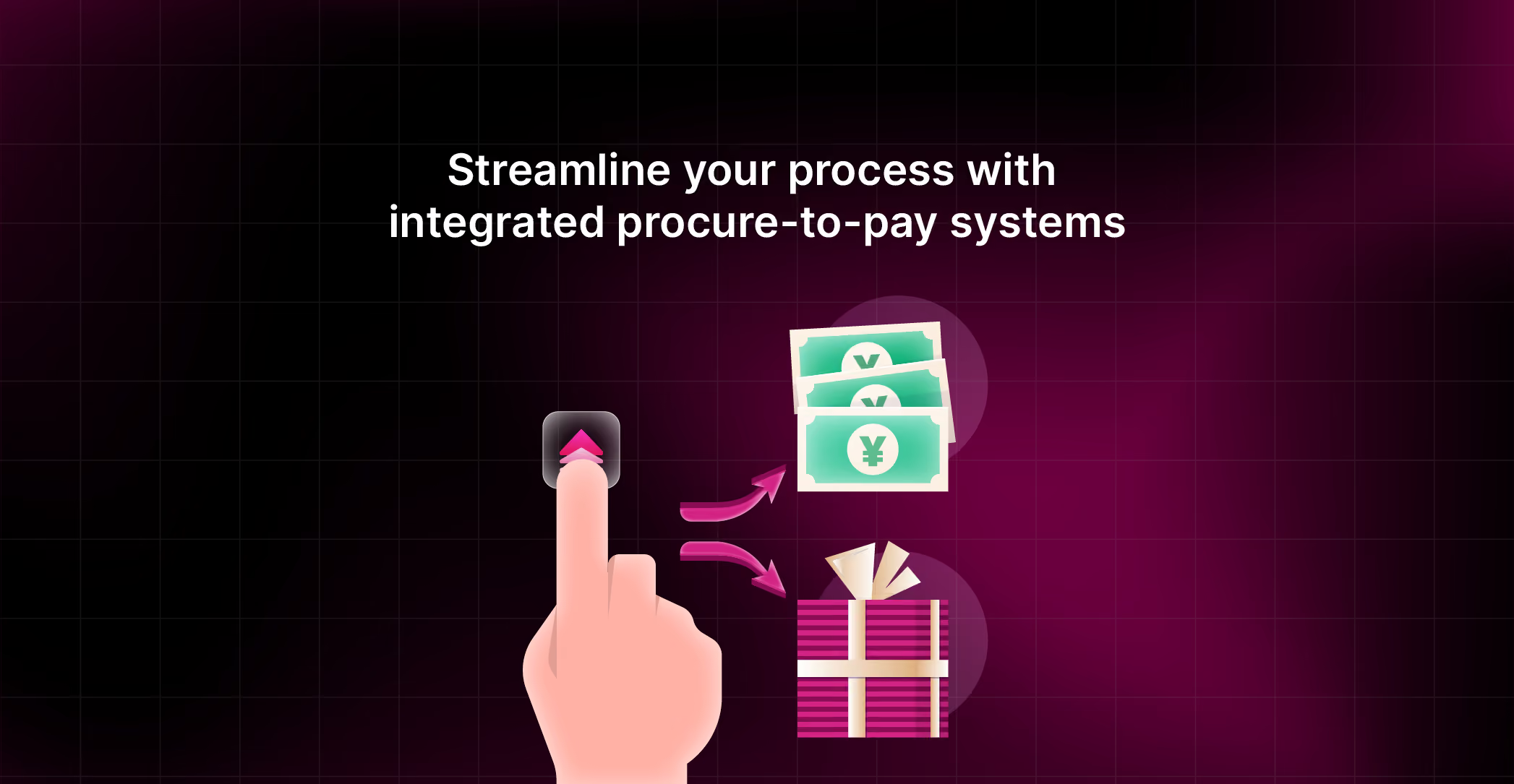

Procure-to-pay (P2P) software connects the whole buying process in one system - from the first purchase request and picking a vendor, to receiving the goods, matching the invoice, and finally paying for it.
The pain points procurement teams run into with P2P software
- ERP alone isn't procurement - and most companies find out the hard way. One operations manager described the exact failure mode: “People just message their manager, get an approval and send the order to the vendor. When anyone raises the PO, the spend was done already.” Their CFO insisted the ERP already covered procurement; it didn't cover anything before the PO - budget checks, vendor selection, approval - which is where the actual spend decision happens (r/procurement).
- Vendor onboarding turns into weeks-to-months of email chaos. One person described a 3-week email chain just to collect W-9s, bank details, and insurance certs, with Finance kicking it back over one missing field. Another reported onboarding taking 3 months of back-and-forth PDF forms - only to discover the vendor was “already in our system under a slightly different name” (r/procurement).
- Weak approval controls cause real financial losses, not just slowness. A 45-person company paid the same vendor twice - “just over 4 grand gone” - because their process was “someone forwarding the invoice email to whoever, a thumbs up in Slack, and paying it.” Nobody could even identify who'd approved the second payment. A commenter's diagnosis: “6-step approvals and zero duplicate detection... now 6 people are signing off on a mistake instead of 2” (r/procurement).
- Enterprise P2P suites are internally disconnected and externally rigid. A recurring complaint about SAP/Coupa/Oracle-class tools: “Different modules don't talk to each other. Purchase orders, financial approvals, invoice matching... each one is a separate planet,” and the systems “resist the slightest change” - “you're forced to adapt to their processes, not the other way around.” One reply called Coupa specifically “a huge dumpster fire of a platform” (r/procurement).
- Buyer's remorse on big P2P purchases is common - and rarely admitted publicly. “Buyer regret is common in enterprise SaaS. It just rarely becomes public because no one wants to document a multi-million-dollar mistake.” Another commenter described how sales teams “get in early and 'help' the decision-makers define the evaluation criteria,” so that “by the time anyone else sees it, the criteria are basically designed so that vendor wins” - with one person estimating this happens in roughly 25% of software procurements, and another admitting they've “essentially made a career of renegotiating and cancelling contracts for under/unutilized software” (r/procurement).
- Contract and renewal tracking gets ignored until it's expensive. One person's supplier went out of business mid-contract because the renewal had lapsed unnoticed a month earlier - despite the company running “all vendor contracts in a procurement software solution.” Their blunt summary of the tool in question (SAP Ariba): “we're paying millions to SAP and all we get is a one line email which can easily be ignored by the buyer” (r/procurement).
How we evaluated these platforms
- Pre-PO visibility and control. Whether the platform actually captures the request, budget check, and vendor selection before a PO exists - or just sits on top of ERP data after the spend decision is already made.
- Vendor onboarding speed and structure. How fast a new vendor goes from first contact to fully onboarded, and whether the system catches duplicate vendor records automatically.
- Approval audit trail and duplicate detection. Whether every approval is logged to a specific person, and whether duplicate invoices or payments get flagged before money goes out.
- Workflow flexibility across modules. Whether procurement, PO, invoicing, and payment share context automatically, or require manual re-entry and rigid, hard-to-change workflows.
- Provable fit before you buy. Whether you can verify the platform actually works for your workflow - via free trial, transparent reviews, or a pilot - instead of a sales-run evaluation where the criteria get shaped to fit the vendor.
- Renewal and contract-obligation tracking. Whether upcoming renewals are surfaced with enough lead time to act, not buried in a one-line email that's easy to ignore.
How the 10 tools compare
Detailed breakdown of the 10 tools
1. Spendflo
Spendflo is a procurement software platform that runs the full purchasing lifecycle in one system - vendor management, contract lifecycle, purchase orders, and accounts payable - backed by an AI agent layer called Flo that handles vendor negotiation and renewals on a company's behalf. For the P2P process specifically, purchase requests carry vendor and budget context from the moment they're submitted, route through approval automatically, and only become a PO once that context is already verified, rather than being handled as a disconnected, later step.
Key features
- Guided intake form. Captures budget, category, and vendor context before a PO exists.
- Autonomous vendor negotiation. Renewal handling runs on the same agent layer.
- Structured, centralized approval flow. Replaces scattered Slack and email approvals.
- Centralized vendor and contract record. Tied to every purchase for traceability.
- ERP integrations. NetSuite and Sage Intacct.
Verdict - A strong pick for mid-market to enterprise companies with meaningful vendor spend and a lean or nonexistent procurement team who want purchase requests to carry vendor and budget context before a PO exists, rather than treating procurement as an afterthought. It's also the tool with the most concrete, vendor-published efficiency numbers in this set (48% faster procurement cycle, 80% reduction in approval times). Not the right choice if native SAP integration is a hard requirement today.
2. Coupa
Coupa is a spend management platform built for large organizations, covering procurement, invoicing, and expense management under one roof, with additional modules for travel and expense reimbursement layered on top. For the P2P process specifically, it centralizes purchase requests and approvals, tracks vendor and supplier performance, and routes everything through configurable workflows before invoices are matched and paid.
Key features
- Centralized purchase requests. Approval workflow built into the same flow.
- Supplier performance tracking. Vendor management handled alongside it.
- Travel and expense module. Reimbursement handled in the same platform.
- Major ERP integration. Includes SAP, Oracle, and NetSuite.
- Spend analytics. Reporting dashboards across categories.
Verdict - Best fit for large enterprises with complex, high-volume procurement needing broad module coverage in one platform. The named vendor-side complaint about the supplier portal experience is worth weighing if your own supplier relationships matter to you, and the AI-feature gap a reviewer names directly means the “AI Enabled” tag shouldn't be taken at face value.
3. SAP Ariba
SAP Ariba is an enterprise procurement platform built around the Ariba Network, a marketplace that connects buyers and suppliers, used to manage the purchasing of indirect goods and services at scale. For the P2P process specifically, it covers the full sourcing-to-payment chain - contracting, purchase orders, invoicing, and payment - with supplier discovery and collaboration built directly into the same network buyers use to transact.
Key features
- Ariba Network. Supplier discovery and collaboration at scale.
- End-to-end visibility. Spans sourcing through payment.
- Centralized supplier management. Spend analysis handled in the same system.
- Multi-ERP integration. Built for large, multi-system enterprises.
- Configurable approval workflows. Compliance-driven by design.
Verdict - Right for large enterprises wanting full sourcing-to-payment visibility across a network of suppliers, but the 6-month implementation and steep learning curve mean it's a poor fit for companies without dedicated procurement/IT resources to manage it long-term.
4. Procurify
Procurify is a procurement platform for finance and operations teams, positioned for growing mid-market organizations that want purchasing, budgeting, and spend control handled in one system. For the P2P process specifically, purchase requests go through budget checks and approval before automatically becoming purchase orders, with spending cards and vendor records tying spend back to policy at every step.
Key features
- Purchase request workflow. Approvals run with budget checks attached.
- Automated PO creation. Generated from approved requests.
- Spending cards. Tied to budget and policy.
- Vendor record management. Supplier records kept in one place.
- Direct integrations. QuickBooks, NetSuite, Sage Intacct, and Dynamics 365.
Verdict - A strong fit for mid-market teams wanting fast, self-service purchasing with minimal setup - the fastest implementation and one of the highest ease-of-use scores in this set. Not built for companies that need deep inventory management or highly flexible, multi-condition approval routing.
5. Precoro
Precoro is a procurement platform built for mid-market companies that want purchasing, e-invoicing, and spend management handled in one connected system rather than across spreadsheets and email. For the P2P process specifically, purchase requisitions become POs through catalog-based ordering and cross-department approval routing, and invoices are matched against those same POs before payment.
Key features
- Purchase requisition workflow. PO creation follows in the same system.
- Catalog-based ordering. Pre-approved items ordered directly.
- Cross-department approval routing. Streamlined across teams.
- AI-driven insights. Drawn from historical purchase behavior.
- 9 ERP integrations. Including NetSuite, Sage Intacct, and QuickBooks Online.
Verdict - A good fit for single-entity mid-market companies that want a straightforward requisition-to-PO-to-invoice flow in one system. Multi-subsidiary companies should be cautious given the named lack of a central cross-entity approval view.
6. Zip
Zip is an AI-native procurement orchestration platform built for large enterprises, designed to route requests and coordinate work across procurement, finance, legal, and IT rather than replacing any single department's existing tools. For the P2P process specifically, customizable intake forms classify and route purchase requests automatically, AI agents handle routine approvals and legal review, and the resulting purchase orders integrate directly into whatever ERP or tech stack the company already runs.
Key features
- Customizable intake forms. Auto-classify and route requests.
- AI-agent handling. Covers routine requests and legal redline review.
- Cross-functional orchestration. Spans procurement, finance, legal, IT, and HR.
- Punchout catalog configuration. Supplier catalogs wired into intake.
- Sits on your existing stack. Integrates into an ERP rather than replacing it.
Verdict - Best fit for large enterprises wanting to unify fragmented intake across procurement, legal, and other departments under one AI-orchestrated system, backed by one of the most detailed, quantified ROI reports in this research set.
7. Tipalti
Tipalti is a finance automation platform built around global payments, covering accounts payable, mass payments, procurement, expenses, and treasury for businesses operating across many countries. For the P2P process specifically, purchase requests and approvals feed directly into Tipalti's payments engine, so procurement, vendor onboarding, and cross-border payment all run through the same system.
Key features
- Purchase request workflow. Approvals feed directly into AP.
- Vendor onboarding. Built-in tax and compliance checks.
- Global payment network. 200+ countries and 120 currencies.
- ERP integrations. NetSuite, QuickBooks, and Dynamics 365.
- Automated invoice-to-PO matching. Runs before payment executes.
Verdict - Best fit for global, multi-entity businesses that want purchase requests and vendor payments running through one connected system spanning 200+ countries - the global payment network remains the core differentiator, not a general-purpose procurement feature set.
8. JAGGAER
JAGGAER is an enterprise procurement and supplier collaboration platform, branded JAGGAER One, built for large, complex organizations that need industry-specific sourcing and supplier tools. For the P2P process specifically, it covers sourcing, contracting, purchase order automation, and supplier onboarding, with suppliers transacting directly through JAGGAER's own portal.
Key features
- Supplier collaboration. Onboarding tools included.
- Sourcing and contract management. Handled in the same suite.
- Purchase order automation. POs generated and routed automatically.
- Industry-specific solutions. Delivered under the JAGGAER One umbrella.
- AI-powered process automation. Per vendor positioning.
Verdict - Best suited to large enterprises with the patience for a 9-month implementation in exchange for deep, industry-specific sourcing and supplier-collaboration features. The vendor-side complaint captured here, plus the thin review base overall, means this evaluation carries less confidence than the other nine tools - worth confirming directly with current customers before committing.
9. Ivalua
Ivalua is an enterprise procurement platform, marketed as “The Enterprise AI Platform for Procurement,” built for large-scale deployments that need deep configurability across sourcing and supplier management. For the P2P process specifically, purchase-to-pay workflows and approval rules can be configured to match a company's exact process, with AI agent add-ons layered on top and integration into systems like SAP.
Key features
- Highly configurable workflows. Approval rules configurable to match.
- Sourcing and supplier management. Covered in the core platform.
- Spend analysis. Reporting across categories.
- AI agent add-ons. Per the vendor's own branding.
- ERP integrations. SAP and others.
Verdict - Best fit for large enterprises with the implementation resources to exploit deep configurability across sourcing, supplier management, and P2P. Reviewers are explicit that the AI-agent add-ons and SAP integration both currently require real effort to get working, so budget for that rather than expecting plug-and-play.
10. NetSuite
NetSuite is a cloud ERP platform covering financials, inventory, HR, and omnichannel commerce, built for companies that want one system running their entire business. For the P2P process specifically, procurement is a native module inside that ERP - purchase requests, POs, and vendor bills post directly to the general ledger alongside the rest of a company's core accounting, rather than living in a separate tool.
Key features
- Native PO and vendor bill management. Tied directly to the general ledger.
- Customizable reports. Saved searches across procurement data.
- Multi-entity support. Multi-subsidiary structures handled natively.
- Broad integration ecosystem. ERP-wide connectivity.
- Inventory and supply-chain visibility. Sits alongside procurement.
Verdict - Right for companies that want procurement embedded in a single ERP system of record rather than run as a separate tool. Its own largest-single complaint - a steep learning curve, the most-cited con of any tool in this set - is the tradeoff every multi-module ERP makes: broad coverage in exchange for complexity.
Core features to look for
- Intake & Requisition. Structured request forms that capture budget, category, and vendor before a PO exists.
- PO Creation & Matching. Automatically generates purchase orders from approved requests and matches them against invoices and receiving reports.
- Approval Workflows. Routes requests to the right approver based on amount, category, or department, with a visible audit trail.
- Vendor & Supplier Management. A central vendor record - onboarding documents, risk status, contract terms - instead of one spreadsheet per department.
- Spend Analytics. Real-time visibility into committed vs. actual spend, by vendor, category, or team.
- ERP Sync. Two-way integration with systems like NetSuite, Sage Intacct, or SAP so approved POs and vendor data flow automatically.
Frequently asked questions
1. What are the best procure-to-pay software platforms for 2026?
The 10 tools compared in this guide: 1. Spendflo, 2. Coupa, 3. SAP Ariba, 4. Procurify, 5. Precoro, 6. Zip, 7. Tipalti, 8. JAGGAER, 9. Ivalua, 10. NetSuite. Best fit depends on company size and whether you want a dedicated P2P tool or procurement folded into a broader ERP.
2. What's the difference between P2P software and a full ERP's procurement module?
Dedicated P2P tools (Spendflo, Procurify, Precoro, Zip) are built around the request-to-pay cycle specifically. NetSuite runs procurement as one module inside a full ERP. Coupa, SAP Ariba, JAGGAER, and Ivalua sit in between - enterprise suites built specifically for procurement, but with the scope and complexity of an ERP-scale rollout.
3. Which of these tools fit small business vs. mid-market vs. enterprise?
Spendflo, Procurify, and Precoro fit mid-market companies with a lean or nonexistent procurement team. Coupa, SAP Ariba, JAGGAER, Ivalua, and Zip are built for large enterprises. Tipalti fits global, multi-entity businesses of any size paying vendors across many countries. NetSuite fits companies of any size already committed to it as their ERP.
4. Do I need a dedicated procurement team to use this software?
No, for the mid-market tools. Spendflo, Procurify, and Precoro are explicitly built for lean or nonexistent procurement teams. The enterprise suites (Coupa, SAP Ariba, JAGGAER, Ivalua) assume dedicated staff to configure and run them - reviewers name real implementation and learning-curve costs on all four.
5. How long does implementation take?
Spendflo: about 1 month. Procurify: 2 months. Zip: 3 months. SAP Ariba: 6 months. JAGGAER: 9 months, the longest in this set. The rest (Coupa, Precoro, Tipalti, Ivalua, NetSuite) don't have public implementation-time data from this research pass.
6. Is the AI in these platforms real, or a bolted-on feature?
Varies. Zip's AI is reviewer-credited with a specific, quantified outcome for deflecting legal requests. Spendflo ships a genuine AI agent, Flo, built to run procurement workflows - intake, vendor management, and renewals - autonomously rather than as a bolt-on suggestion layer. Coupa is tagged "AI Enabled," but a reviewer directly names "lack of support chatbot or AI agents" as a gap. Ivalua reviewers report "issues implementing the AI use cases from the add-on store." NetSuite and SAP Ariba make no procurement-specific AI claim captured in this research.


.avif)










.avif)
.avif)