



“Nearly 40% of companies say they overspend on SaaS subscriptions without realizing it,” notes a recent Deloitte report. As software becomes the backbone of every modern business, these hidden costs quietly chip away at profits.
SaaS spend has grown faster than any other operating expense in the past decade. Finance and procurement teams are now under pressure to make sense of sprawling subscriptions, unpredictable renewals, and fragmented billing. This makes understanding SaaS pricing models and how to manage them more important than ever.
What is a SaaS Pricing Model?
A SaaS pricing model is how software-as-a-service companies charge customers, typically through recurring subscriptions. Common models include flat-rate, tiered, per-user, and usage-based pricing. Each approach aims to match the cost with customer needs, perceived value, and sustainable business growth.
Why CFOs must pay attention to SaaS costs
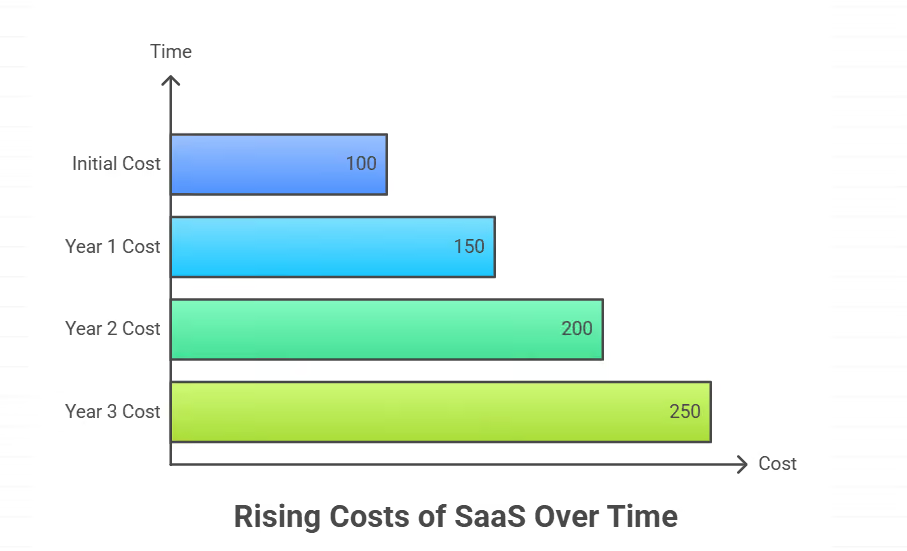
SaaS is an expensive affair
SaaS is one of the top three expenses of any high-growth organization today. Organizations are spending over $5 million on software to optimize productivity, organizational efficiency, and process effectiveness.
SaaS pricing is complex
SaaS has become akin to consumer packaged goods that don’t have standardized sizes, making direct comparison practically impossible. Based on users, usage, functionalities, features, value etc. cost models vary widely.
SaaS pricing is opaque
The enterprise-level plans of SaaS products are often behind a form. In order to find how much something costs, procurement teams have to go through discovery, demos and negotiations. So, they don’t evaluate all options possible.
SaaS buying is decentralized
The ease procuring SaaS by individuals has led to employees buying on their own and reimbursing later. This hinders visibility and forecasting.
SaaS wastage is common
Every organization has SaaS tools that employees dislike or licenses that no one uses. Little by little, these leaks add up to a significant portion of SaaS spends.
Controlling overspending, minimizing wastage and optimizing expenses begins with an understanding of how SaaS pricing works. This primer is intended to help you with that.

The Psychology Behind SaaS Pricing
Pricing isn’t just about numbers, it’s about perception. The way you structure and present prices can shape how customers see value and make decisions. That’s where psychological pricing in SaaS comes in. Let’s look at a few principles that can make a real difference.
Price Anchoring
Price anchoring is the practice of presenting a higher-priced option first to make other plans seem more reasonable. For example, when a SaaS company lists an enterprise plan before showing the standard or basic tier, it creates a mental “anchor” that makes the lower tiers feel like better deals. This strategy helps guide users toward the plan that delivers the most perceived value.
Charm Pricing ($99.99 Effect)
Charm pricing is the simple idea that prices ending in .99 or .95 feel significantly cheaper than rounded numbers. A plan at $99.99 appears more affordable than $100, even though the difference is negligible. In SaaS pricing psychology, this subtle cue can improve conversions and make pricing pages feel more customer-friendly.
Decoy Pricing
The decoy effect happens when you introduce a third, less-attractive pricing option that makes another plan look more appealing. For instance, adding a mid-tier plan that’s close in price to a premium plan nudges users toward the higher-value option. It’s a common tactic in psychological pricing for SaaS, helping customers justify their choice logically while the business drives higher revenue.
An Overview of Common SaaS Pricing Models
SaaS pricing isn’t one-size-fits-all. Each model comes with its own benefits and tradeoffs, and understanding them helps finance and procurement teams make informed decisions. Let’s look at the most common pricing models used across the SaaS industry today.
1. Flat-Rate Pricing
Flat-rate pricing is the simplest model: customers pay a single fixed fee for access to all features. It’s easy to understand and even easier to bill. Few companies use it today, but Basecamp is a well-known example, charging $299 per month (billed annually) for unlimited users and projects.
Pros
- Easy to explain and manage for both vendors and customers.
- Predictable monthly cost, no hidden fees or variable usage.
- Simplifies budget planning and expense approvals.
Cons
- Limited flexibility, small teams may end up overpaying.
- Not scalable for fast-growing organizations.
- Fails to reflect actual usage or value derived.
2. Per-User (Seat-Based) Pricing
Per-user pricing charges customers for each person using the software. It’s common among project management and collaboration tools such as Slack, Asana, and Trello.
Pros
- Predictable and easy to calculate, cost grows with headcount.
- Simple onboarding and billing structure.
- Scales well for smaller teams with fixed roles.
Cons
- Costs can escalate quickly as the team expands.
- Downgrading or reducing seats can be difficult with vendor lock-ins.
- May discourage tool adoption if teams share limited licenses.
3. Usage-Based (Consumption) Pricing
Usage-based pricing, sometimes called “pay-as-you-go”, charges customers based on how much they use the product. AWS, Mailchimp, and Stripe use this model, tying cost to metrics like data processed, contacts reached, or transactions completed.
Pros
- Flexible and fair, you pay only for what you use.
- Scales naturally with business activity.
- Ideal for seasonal or usage-fluctuating companies.
Cons
- Harder to forecast monthly expenses.
- Can lead to unexpected bills from unmonitored usage.
- May include additional setup or onboarding fees.
4. Freemium Pricing
The freemium model combines free access with optional paid tiers. Users can try basic features for free and upgrade for premium capabilities. Tools like Dropbox, Evernote, and Hootsuite use this approach.
Pros
- Low barrier to entry for new users.
- Helps drive brand awareness and trial adoption.
- Allows teams to test tools before committing financially.
Cons
- Limited features in the free version often force upgrades.
- Conversion from free to paid users can be slow.
- High cost of supporting non-paying users.
5. Tiered or Value-Based Pricing
Tiered or value-based pricing aligns cost with the value customers receive or the features they use. It’s flexible and common among mature SaaS businesses like Zenefits, Drift, and DataDog.
Pros
- Offers flexibility, customers choose plans that fit their needs.
- Encourages upselling as users grow into advanced tiers.
- Can combine multiple factors (users, features, usage).
Cons
- Customers may pay for unused features bundled into higher tiers.
- Difficult to manage when teams require mixed access levels.
- Pricing can become complex, making comparison harder.
How to Track and Analyze Your Pricing Model?
Tracking and analyzing your pricing model is crucial for ensuring profitability and customer satisfaction. By evaluating metrics such as LTV/CAC ratio, gross MRR churn, and expansion MRR, you can assess whether your pricing strategy is sustainable and profitable, allowing for informed decisions and adjustments.
Here are key metrics to track and analyze:
LTV/CAC Ratio
The LTV/CAC ratio compares the lifetime value of a customer to the cost of acquiring that customer. A ratio greater than 1 shows profitability, while a lower ratio signals potential losses. Tracking this ensures your business isn’t overspending on acquisition compared to customer value.
Gross MRR Churn
Gross MRR churn measures revenue lost due to cancellations or downgrades. A high churn rate, especially over 5%, can indicate customer dissatisfaction or a misaligned pricing model. Keeping churn low helps maintain revenue stability and long-term growth.
Expansion MRR
Expansion MRR tracks additional revenue from upselling and cross-selling to existing customers. It’s a sign of sustainable growth, as you increase customer lifetime value
without acquiring new customers. A high expansion MRR means you're successfully adding value and monetizing relationships.
Upgrade MRR
Upgrade MRR measures revenue from higher-tier plans. This metric shows how effectively your product encourages users to pay for advanced features. A rising upgrade MRR indicates a strong value proposition and the right pricing for premium offerings.
How to Choose the Right SaaS Pricing Model for Your Business
For starters, SaaS vendors decide the price for their products, and customers do not have much say. Few vendors offer the customer choice of pricing model. Therefore, if you don’t like a tool’s pricing model, you will need to choose another tool altogether. To help you in that evaluation, here are some pointers.
Forecast total SaaS costs before signing the contract
Whatever the pricing model, give the SaaS vendor the number of users, quantum of usage, features needed, etc., to identify how much the tool is going to cost you for the next year or a few years.
Understand limits and overages
Even in usage-based pricing, there are often tiers for units of measure. For instance, Chargebee’s performance tier costs $599 for up to $100K of billing per month and 0.75% on billing thereafter. Such overages can turn out to be significantly more expensive than you anticipated. So, be more precise in your forecasts.
Benchmark against similar products
For every need, there are dozens of SaaS tools. While it is not practical to evaluate all of them, pick your top 3-5 and compare prices. It also helps to know what organizations similar to yours are paying for these tools.
Build mechanisms to track usage
Without your own systems to track usage, you’ll have to trust the vendor’s word alone for the costs you incur. While this is likely to be accurate, you might be incurring unnoticed wastage. To prevent that, set up a SaaS management solution to track licenses, usage, and costs.
Always negotiate the price
Depending on a number of factors, such as the number of users, contract length, payment options, etc., vendors offer discounts. Once you receive a proposal from a vendor, always negotiate the price with them. Understand their motivations and make a mutually beneficial offer.
Keep an eye out for promotional pricing
SaaS vendors offer promotional pricing to startups and small businesses. There are also huge discounts in the first year. Some vendors offer purchasing parity discounts for organizations in the global south. Some also offer special discounts to those switching from a competitor. Build rapport with the account executive to see which of these you can claim.
SaaS Pricing Strategies: Beyond the Model
Selecting the right pricing model is only part of the equation. To maximize growth and profitability, SaaS companies also need smart SaaS pricing strategies, structured approaches to decide how prices are set, tested, and evolved. Here are three of the most effective SaaS pricing tactics used across the industry today.
1. Value-Based Pricing
Value-based pricing sets prices based on the customer’s perceived value rather than just product features or costs. The goal is to charge what your product is truly worth to the buyer, often tied to measurable outcomes like revenue growth, time savings, or productivity gains.
Example: A financial automation tool that helps CFOs save hundreds of work hours each quarter can charge more than one that simply offers reporting dashboards.
Pros
- Aligns pricing with customer outcomes and success.
- Builds stronger relationships by focusing on delivered value.
- Often leads to higher margins and customer retention.
Cons
- Requires in-depth customer research and pricing analysis.
- Difficult to implement for new or niche products.
- Pricing can vary widely across customer segments.
2. Cost-Plus Pricing
Cost-plus pricing is one of the most straightforward SaaS pricing strategies. The company calculates total operational costs, such as infrastructure, development, and support, and adds a markup to ensure profit.
Example: If it costs $8 per user per month to run a SaaS platform, the vendor might charge $12 to maintain a 50% margin.
Pros
- Simple to calculate and implement.
- Guarantees a profit margin on every plan.
- Offers transparency and predictability.
Cons
- Doesn’t consider customer perception of value.
- Can limit pricing flexibility in competitive markets.
- May lead to missed revenue opportunities for premium products.
3. Competitive Pricing
Competitive pricing involves setting prices based on what similar SaaS products charge. It’s a common SaaS pricing tactic for startups entering established categories or companies looking to reposition themselves.
Example: A workflow automation tool might price itself slightly below Asana or ClickUp to attract cost-sensitive teams.
Pros
- Easy to benchmark and position in the market.
- Helps capture attention in crowded spaces.
- Useful for early-stage customer acquisition.
Cons
- Can trigger price wars and erode margins.
- Overlooks unique product value or differentiation.
- Risk of underpricing high-value capabilities.
Let Spendflo do the SaaS buying heavy lifting
Managing SaaS renewals, vendor contracts, and pricing negotiations can feel never-ending, especially when every department brings in new tools faster than finance can track them. Without the right visibility, overspending becomes the norm rather than the exception.
One of our customers, a high-growth fintech firm, saved over $400,000 in their first year with Spendflo by consolidating renewals, eliminating duplicate tools, and automating vendor negotiations. Their procurement cycle time dropped by 40%.
The truth is, manual SaaS buying isn’t sustainable. Costs add up, approvals stall, and forecasting gets messy.
That’s where Spendflo steps in. Our expert buying team and AI-native procurement platform handle vendor sourcing, pricing benchmarks, renewals, and negotiations, all while delivering up to 30% in savings.
Ready to take SaaS buying off your plate? Book your free demo today.
Frequently Asked Questions
1. What is the difference between usage-based and tiered SaaS pricing?
Usage-based pricing charges you based on what you actually consume - API calls, active users, data processed - making costs variable and harder to forecast. Tiered pricing bundles features or usage into fixed plans, offering more predictability.
For finance teams, tiered pricing is easier to budget and approve, while usage-based models require closer monitoring to avoid surprise overages.
2. How does AI pricing differ from traditional SaaS pricing models?
Traditional SaaS pricing is typically seat-based or tiered with fixed monthly costs. AI-powered tools increasingly use token-based or outcome-based billing, where costs fluctuate with how much the AI is used.
In 2026, ~65% of SaaS vendors have introduced hybrid models combining seat fees with an AI usage meter - making cost forecasting significantly harder for procurement and finance teams.
3. Can SaaS pricing models be negotiated?
Yes, but the leverage varies by model. Seat-based plans offer the most room for negotiation through volume discounts, multi-year commitments, or payment terms. Usage-based plans can sometimes be negotiated with committed spend thresholds in exchange for discounted rates.
Having pricing benchmark data - knowing what similar organizations pay - is the most effective way to enter any SaaS pricing conversation with confidence.
4. What happens when a SaaS vendor switches pricing models mid-contract?
Vendors can and do change pricing models, especially when introducing AI features or moving from per-seat to usage-based billing. This is a growing risk in 2026. Always ensure your contract includes price lock clauses, auto-renewal notice windows, and clear terms on what triggers a pricing change.
Monitoring vendor announcements and renewal timelines proactively helps avoid being caught off guard.
5. How should a CFO evaluate SaaS pricing before signing a contract?
Start by forecasting total cost of ownership - not just the headline price, but projected usage, likely overage fees, and expansion costs as your team grows. Benchmark the pricing against what similar companies pay for the same tool.
Understand the model's predictability (flat-rate and tiered are easier to budget; usage-based requires closer monitoring). Finally, always request multi-year pricing options to lock in rates before the vendor increases prices.


-compressed.avif)













.avif)
.avif)